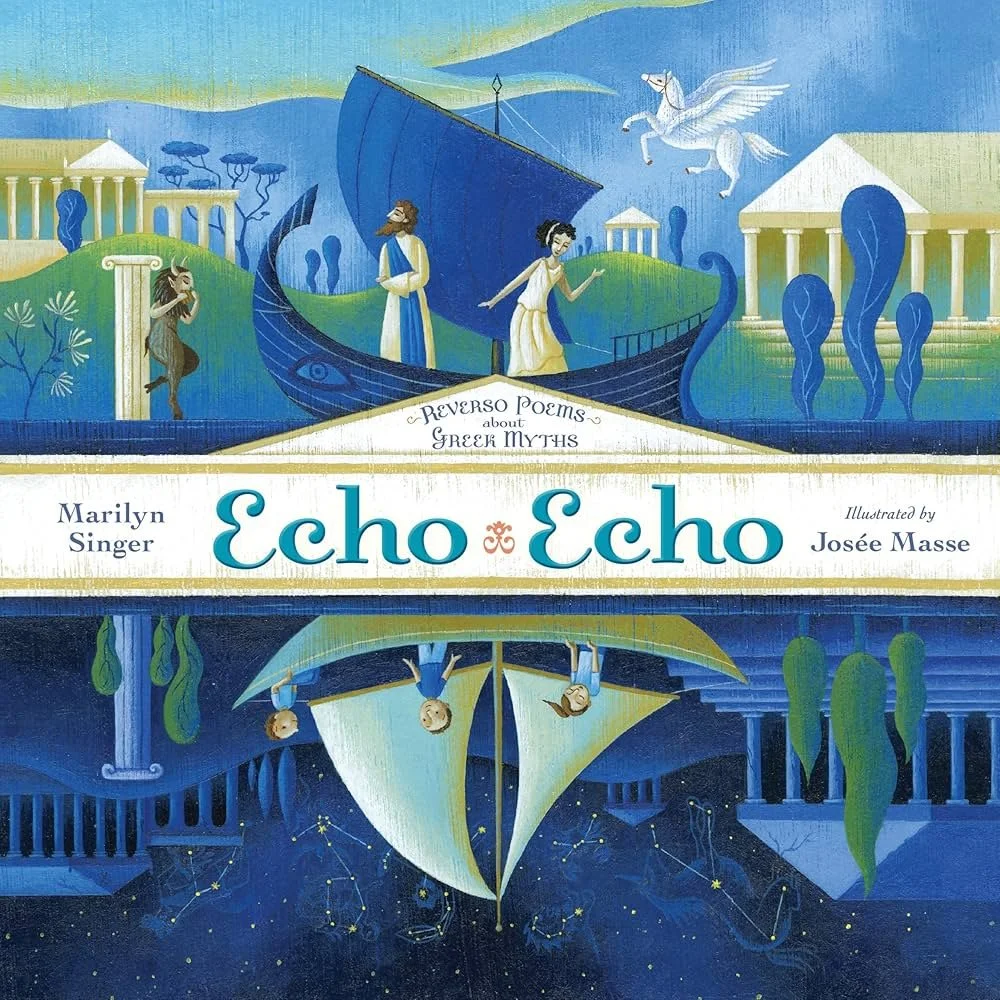
Title: Echo Echo: Reverso Poems About Greek Myths
Author: Marilyn Singer
Illustrator: Josée Masse
Date: 2016
Tags: Middle Grade, Picturebook, Mythology, Pandora, Midas, Perseus and Medusa, Pygmalion, Icarus and Daedalus, Demeter and Persephone, Echo and Narcissus, Ancient Worlds, Read Aloud, English
Readers interested in a scholarly approach to children’s literature may consult this title on Our Mythical Childhood Survey*
Marilyn Singer’s Echo & Echo tells twelve mythological stories, from Arachne and Athena to Perseus and Medusa, using the unique “reverso poem” style (created by Singer herself). A reverso is a poem that can be read both forwards and backwards with each version often offering contrasting meanings. The reverso poem structure mirrors the complexity of mythological stories, showing how the same events can be viewed in dramatically different ways depending on the speaker’s perspective. Each mythological tale includes an illustration depicting the events in the tale, two to four sentences recounting the events in the story, and a reverso. Some of these mythological stories provide explanations for events we experience in our everyday lives. For instance, the tale of Demeter and Persephone explains the origin of the seasons. The story of Pandora and the box shows why there are evils on the Earth. In addition, the picturebook is tailored to beginners in the world of Greek mythology. The book is written in simple terms and retells some of the most prominent mythological tales, such as Perseus and Medusa, Theseus and Ariadne, and Icarus and Daedalus. Overall, I highly recommend this book to readers of all ages who are interested in Greek mythology, poetry, or storytelling. Its creative format, clear language, and engaging visuals make it an excellent introduction to the Greek myths. - Nayan (age 15)
* For further information on the Our Mythical Childhood Survey, please refer to the website of the project “Our Mythical Childhood” [link: http://omc.obta.al.uw.edu.pl/], led by Prof. Katarzyna Marciniak at the Faculty of “Artes Liberales,” University of Warsaw, Poland, with the participation of Bar Ilan University, University of New England, University of Roehampton, University of Yaoundé 1, and other affiliated scholars, within the funding from the European Research Council (ERC) under the European Union’s Horizon 2020 Research and Innovation Programme (grant agreement No 681202).